

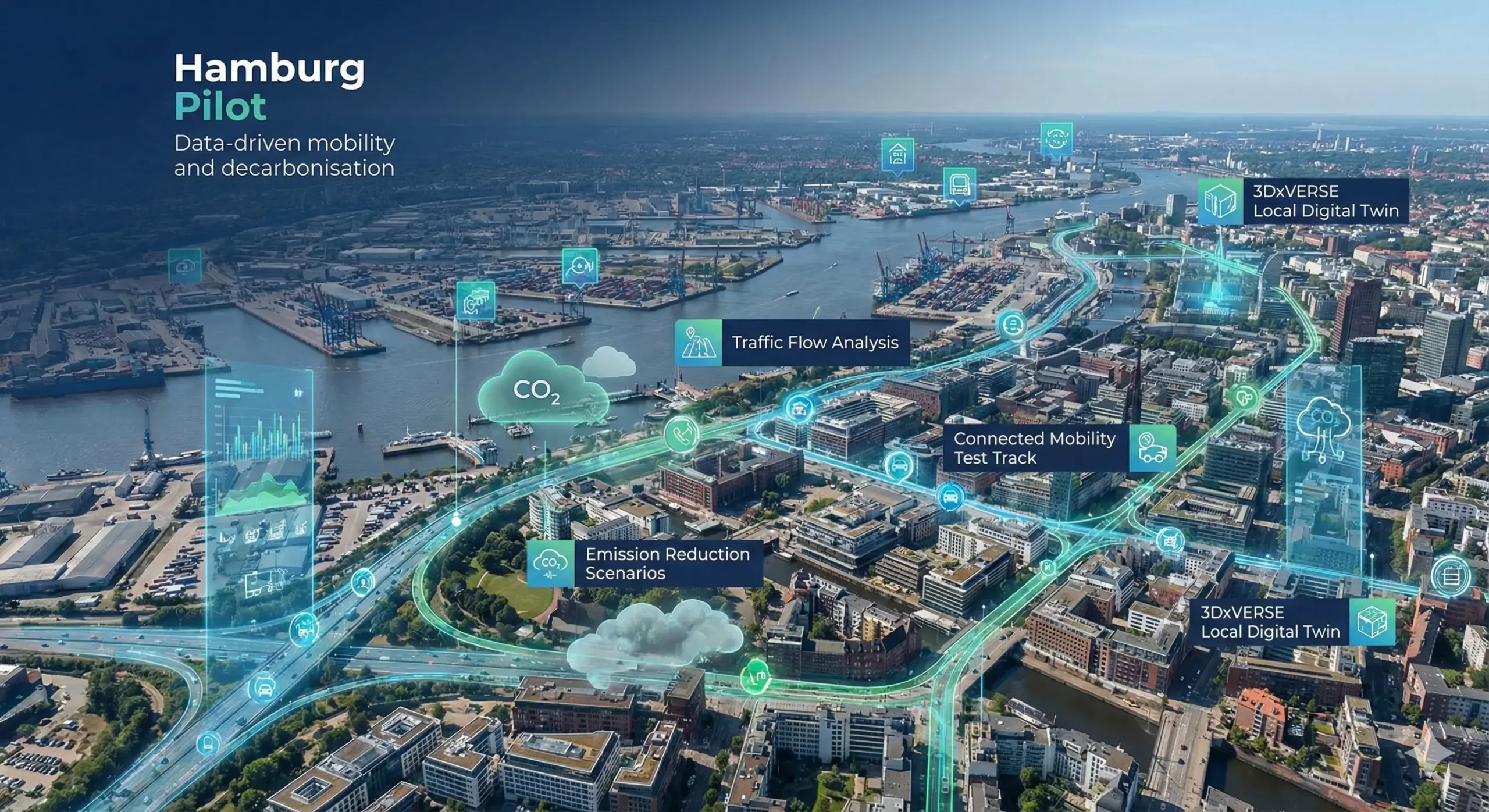
Hamburg Pilot
Hamburg as a 3DxVERSE Pilot City
Data-driven mobility and decarbonisation through a Local Digital Twin
Hamburg is one of the 3DxVERSE pilot locations focusing on sustainable urban mobility and intelligent transport systems (ITS). As a major European port city with complex traffic flows and high transport demand, Hamburg provides an ideal environment to demonstrate how Local Digital Twins (LDTs) can support data-driven decision-making for traffic management, emission reduction, and connected mobility.
Within 3DxVERSE, the Hamburg pilot builds on existing infrastructure and historic datasets from connected and automated mobility test tracks in the city centre, translating real-world mobility data into an interactive digital twin environment.
Co-funded by the European Union
3DxVERSE is funded under the Digital Europe Programme — developing interoperable, trustworthy Digital Twins for sustainable travel and living communities.
Why Hamburg?
A Major Port City with Complex Urban Mobility Challenges
Hamburg is a city port, with terminals distributed across the urban area. This creates specific challenges related to:
Traffic Congestion
Traffic congestion during peak hours, driven by port activity and urban demand.
Multimodal Accessibility
Multimodal accessibility between port, city centre, and public transport networks.
Environmental Impact
CO₂ emissions, air pollution, and noise affecting residents and visitors across the city.
Quality of Life
Quality of life for residents and visitors impacted by mobility pressures.
To address these challenges, Hamburg has established policy frameworks and testbeds for connected, cooperative and automated mobility (CCAM), including a test track for connected and automated driving (TAVF) in the city centre.
The Hamburg pilot leverages these initiatives to explore how digital twins can visualise, quantify, and assess the environmental impact of mobility measures.
What Is Being Piloted?
Urban Mobility and Traffic Management
The Hamburg Local Digital Twin focuses on urban mobility and traffic management, using real-world mobility data to model and analyse:
Traffic Flow Patterns
Traffic flow patterns around the connected mobility test track, including hotspots and peak-hour congestion.
Carbon Emissions
Carbon emissions linked to road traffic, quantified per road segment and time period.
ITS Impact
The impact of intelligent transport services on emissions and traffic efficiency.
The digital twin enables stakeholders to explore scenarios, compare alternatives, and better understand how different mobility strategies affect emissions and traffic dynamics.
Key Use Cases in Hamburg
Three Focus Areas for the Hamburg Pilot
Connected and Automated Mobility (ITS)
The Hamburg pilot demonstrates how intelligent transport systems — such as Time-to-Green and Time-to-Red traffic light information — can support:
These services are particularly relevant for electric and automated shuttle services integrated into Hamburg’s public transport ecosystem.
Traffic and Carbon Footprint Monitoring
Using historic and aggregated mobility data, the digital twin:
This supports authorities and mobility operators in assessing the environmental impact of traffic measures.
Decision Support for Urban Traffic Management
By integrating mobility data into a Local Digital Twin, the Hamburg pilot supports:
The focus is on making complex mobility data understandable and actionable for decision-makers.
Data and Technologies
Built on Existing Datasets and Standards
The Hamburg pilot builds on existing datasets and standards, including:
Historic floating car data from taxis and shuttle fleets
Mobility data via smartphone and telematics applications
Traffic light information (Time-to-Green / Time-to-Red)
ISO-23795-based methodologies for energy and emission assessment
A 3D digital map of the Hamburg test track area
The digital twin integrates these data sources into a visual, scenario-driven environment.
Who Benefits?
Designed for a Wide Range of Stakeholders
The Hamburg pilot is designed to support a wide range of stakeholders, including:
Traffic and environmental authorities
Urban mobility planners
Public transport and shuttle operators
Taxi, fleet and logistics operators
Mobility-as-a-service providers
By making mobility impacts visible in a digital twin, the pilot helps stakeholders evaluate options, quantify impacts, and support evidence-based policy decisions.
Hamburg within 3DxVERSE
Contributing to a Shared European Framework
The Hamburg pilot is part of the broader 3DxVERSE initiative, which develops interoperable, citizen-centric Local Digital Twins across multiple European and international locations.
Insights, methodologies, and use cases developed in Hamburg are designed to be reusable and scalable, contributing to a shared European framework for sustainable, data-driven mobility.